

China has transformed from a former market for European carmakers into their most serious competitor
The European automotive industry is experiencing difficult times. In just a few years, China has become the largest global exporter of automobiles. In 2021, the country exported less than 1 million cars, this year it is already 8.8 million – more than twice as many as Japan.
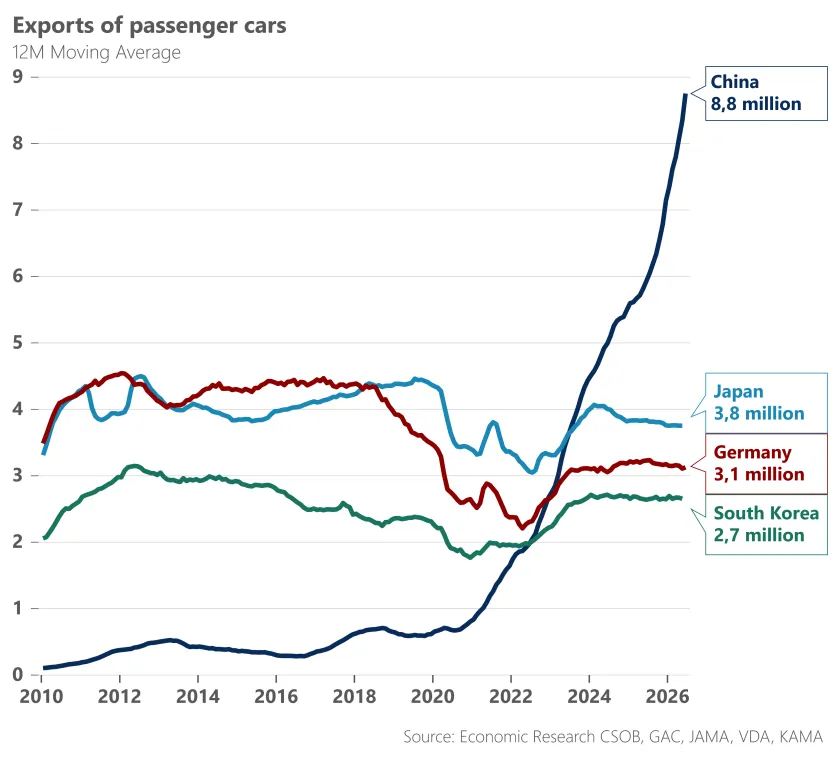
At the same time, the European automotive sector is facing two Chinese shocks at once. The first takes place in the Chinese market, which has long been key for European carmakers in terms of sales and profitability. The second shock is even more serious for Europe, as Chinese manufacturers begin to aggressively enter the European market. Just to illustrate: this year, Chinese brands already account for 10% of sales, but in the case of hybrids, it is more than two-fifths – in 2024 it was less than 3%. This obvious trend is and will continue to be reflected in the situation of Czech suppliers for the automotive sector. Some of them have had to reduce their working hours, switch to a four-day work week or lay off due to fluctuations in demand and the transformation of the industry. In general, the automotive sector is not considered an attractive acquisition field within M&A.
And what is behind the success of Chinese carmakers? High competitiveness supported by three factors: 1) production overcapacity and fierce domestic competition, which pushes car prices down; 2) faster innovations in electromobility and software; 3) A strong battery and supply ecosystem.
But that's not all. China's success is not only the result of higher efficiency or natural comparative advantage, but also the result of tough industrial policies and generous subsidies: from cheaper capital, tax breaks to research grants or public procurement.
European carmakers are not only competing with Chinese manufacturers. It also indirectly competes with the Chinese industrial model. And it is based on neo-mercantilist policies: China vehemently supports its own exports, but deliberately suppresses car imports from the rest of the world.
An effective response to Chinese pressure? On the one hand, to protect the European market from unfair competition, but at the same time to restore cost/technological competitiveness through an active industrial policy. From Europe's point of view, it is necessary to tighten up in protecting its own industrial base and to act more assertively against Chinese competition, which benefits from state aid, extensive overcapacity and asymmetric access to the market.
At the same time, however, it is not possible to rely on the protection of the domestic market alone to replace competitiveness in the long term. The European automotive industry needs to produce technologically attractive, software-advanced and affordable cars on a large scale again.
This time there is a lot at stake. The European automotive industry accounts for around 7% of the EU's GDP and provides around 13 million jobs. It is therefore a key sector, the future of which is not only an economic issue, but also increasingly a political one, given the risk of massive layoffs.